


Calculate your benefits

Data-driven support: How Aberdeen City Council used LIFT to deliver discretionary support to households impacted by the benefit cap

  • Challenge: Identifying and reaching Residents who miss out on crucial Support
  • Solution: Lifting people out of crisis with targeted support
  • Impact: Support proactively delivered to 86 vulnerable households

Published July 2026

Aberdeen City Council faced the challenge of proactively identifying residents impacted by welfare reforms who were eligible for but not receiving Discretionary Housing Payments (DHPs), something they were unable to do with their existing tools and systems.

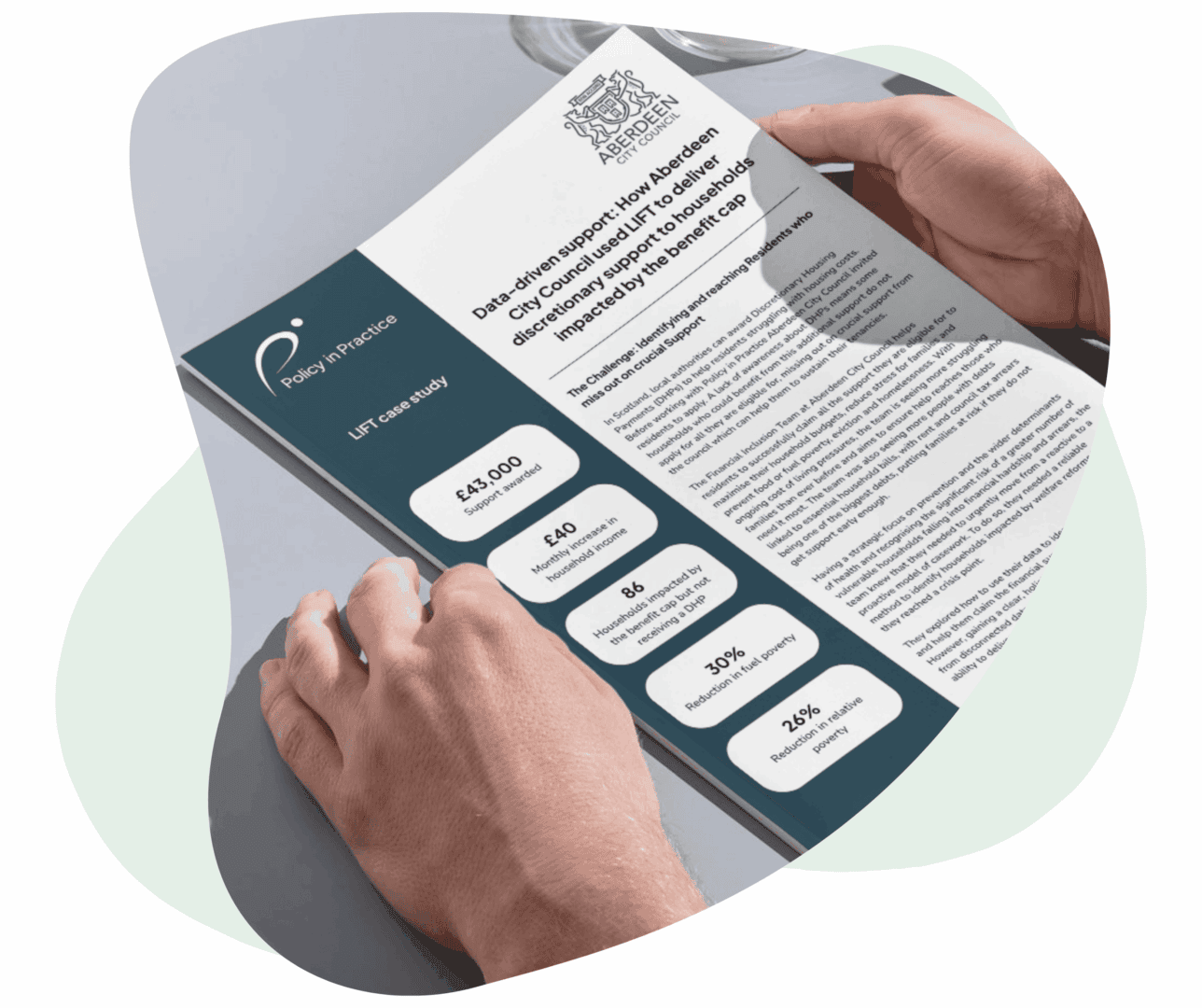
To overcome this, and in a collaboration between the Council’s Financial Inclusion Team and the Health Determinants Research Collaboration (Aberdeen), they adopted the Policy in Practice Low Income Family Tracker (LIFT) platform, which enabled the council to identify 86 households impacted by the benefit cap, leading to a targeted campaign that awarded £43,000 to help residents.

Challenge: Identifying and reaching residents who miss out on crucial support

In Scotland, local authorities can award Discretionary Housing Payments (DHPs) to help residents struggling with housing costs. Before working with Policy in Practice Aberdeen City Council invited residents to apply. A lack of awareness about DHPs means some households who could benefit from this additional support do not apply for all they are eligible for, missing out on crucial support from the council which can help them to sustain their tenancies.

The Financial Inclusion Team at Aberdeen City Council helps residents to successfully claim all the support they are eligible for to maximise their household budgets, reduce stress for families and prevent food or fuel poverty, eviction and homelessness. With ongoing cost of living pressures, the team is seeing more struggling families than ever before and aims to ensure help reaches those who need it most. The team was also seeing more people with debts linked to essential household bills, with rent and council tax arrears being one of the biggest debts, putting families at risk if they do not get support early enough.

Having a strategic focus on prevention and the wider determinants of health and recognising the significant risk of a greater number of vulnerable households falling into financial hardship and arrears, the team knew that they needed to urgently move from a reactive to a proactive model of casework. To do so, they needed a reliable method to identify households impacted by welfare reforms before they reached a crisis point.

They explored how to use their data to identify vulnerable families and help them claim the financial support they were eligible for. However, gaining a clear, holistic view of resident circumstances from disconnected datasets was a major challenge, hindering their ability to deliver targeted, preventative support.

Solution: Lifting people out of crisis with targeted support

Having secured funding from the Child Poverty Accelerator Fund in 2024, Aberdeen City Council started using Policy in Practice’s LIFT platform in January 2025. LIFT’s policy engine combines and analyses council datasets to provide a much clearer picture of a resident’s current situation. This includes their tenancy status, benefit eligibility and the impact of welfare reforms on low income residents as well as linking to other datasets on arrears and previous crisis support.

Impact: Support proactively delivered to 86 vulnerable households

Data-driven insights from the LIFT dashboard enabled the team to pinpoint specific households in need with just one click. They identified 86 households impacted by the benefit cap but not receiving a DHP.

Armed with this precise information, officers launched a campaign between January and March 2025, focused on engaging the 86 households affected by the benefit cap, proactively inviting them to apply for a DHP to mitigate the shortfall in their housing costs and maximise their income.

Campaigns results and analysis

By December 2025, 26 households who had been identified as being benefit capped in Jan 2025 were awarded a DHP. We compare these households against those who did not receive support despite being invited to (60 households) to see effectiveness of their campaign:

1. Eliminating Cash Shortfalls

The DHP proved highly effective in keeping households out of immediate financial crisis.

  • With DHP: Two households began the year in a cash shortfall (unable to meet essential costs). By December, these households were no longer in shortfall. On average, households had an additional £40 per month after meeting their essential costs, compared to those without the DHP.
  • Without DHP: Households without the payment saw no improvement, with one household remaining in cash shortfall throughout the year.

2. Reducing Fuel Poverty

Fuel poverty is defined in LIFT as when a household’s income is below the relative poverty line, or if fuel expenditure would bring it below that line.

  • With DHP: Fuel poverty dropped by 30%, falling from 23 households in January to 16 in December, as families had more money overall to cover fuel costs.
  • Without DHP: There was virtually no change (36 households in January vs 35 in December).

3. Tackling Relative Poverty

Households are considered to be at risk of being in relative poverty if their total equivalised household income is below the UK poverty line (defined as 60% of median household income).

  • With DHP: 19 households started in relative poverty. By December, this dropped to 14, representing a 26% reduction in relative poverty for those receiving long-term support.
  • Without DHP: There was no change in the number of households in relative poverty.

4. Housing Benefit Overpayments and the Benefit Cap

  • With DHP: This cohort saw a 34% reduction in Housing Benefit Overpayments (approx. £1,934). Furthermore, 10 fewer households were benefit capped by December, suggesting the support enabled positive changes in circumstances, such as finding work.
  • Without DHP: Overpayment levels remained the same, and only one less household was impacted by the benefit cap.

Among these households, the residents who received a DHP were 24% less likely to fall into large council tax arrears compared to those who did not receive DHP support.
Overall, the outcome was less favourable for those who were invited to claim DHP but did not take it up. The data clearly demonstrates that DHP was highly effective in helping households escape poverty and maintain financial stability.
By using LIFT to turn data into action, the council ensured that discretionary support was not just available, but actively delivered to vulnerable households. This campaign aligns with Aberdeen City Council’s focus on the wider determinants of health and commitment to preventing homelessness by supporting families to sustain their tenancies, as referenced in their Poverty and Inequalities Corporate Plan.
DHPs are a vital part of the solution, as they can be a lifeline for households at risk of falling into financial hardship.

Key takeaways for local authorities

The partnership between Aberdeen City Council and Policy in Practice demonstrates the power of a data-driven, proactive approach to public service delivery, particularly in this case study the allocation of discretionary support.

Technology served as a key enabler, creating immediate efficiencies and allowing the teams to deliver more support, faster, to those who need it most. By accurately identifying households in need, the council delivered targeted interventions that made a tangible financial impact on residents’ lives, helping them to sustain their tenancies and avoid crisis.

The success of the initial campaign has provided a strong foundation for future work. The council is now progressing with the second phase of its campaign, using insights from LIFT to engage residents affected by the bedroom tax. This ongoing collaboration will continue to enhance the council’s ability to allocate resources efficiently and support the financial wellbeing of the Aberdeen community.

Download printable PDF of case study

Aberdeen Case Study

Want to know more about what Aberdeen City Council did?

By submitting this form I confirm that I have read the privacy policy and agree to the processing of my personal data by Policy in Practice for the stated purposes. I can revoke my consent to this processing at any time

Request a Demo

Name(Required)
Organisation name

Book a Call

Book a Call

Health Foundation report
scroll to top