

The Greenwich Supports Pilot | Policy in Practice | Benefits calculator and data analytics
Calculate your benefits

The Greenwich Supports Pilot

Challenge: Traditional support models addressed issues too late and in isolation

Solution: A multi-disciplinary team proactively identified vulnerable residents and delivered coordinated, wraparound support

Impact: The pilot improved residents’ financial resilience and delivered significant savings for both residents and the council


Published July 2026


Challenge: Traditional support models addressed issues too late and in isolation

Traditional, reactive support models often address single issues in isolation, failing to account for the complex realities of residents’ lives. This approach also means that intervention often comes too late.

Royal Borough of Greenwich hypothesised that a more holistic, person-centred approach could identify and resolve underlying issues that might otherwise go unnoticed. In alignment with the DWP’s Crisis and Resilience Fund (CRF) framework, the project aimed to shift from reactive services to proactive, preventative support, to build sustainable financial resilience for residents while generating significant long-term cost savings for the council.
Solution: A multi-disciplinary team proactively identified vulnerable residents and delivered coordinated, wraparound support

To achieve this, Royal Borough of Greenwich established the ‘Greenwich Supports’ pilot, creating a multi-disciplinary team of eight full-time advisors. Rather than operating in silos, Royal Borough of Greenwich brought together specialists across key areas:

  • Money Advice: Debt management and financial literacy
  • Welfare Rights: Income maximisation and benefits advice
  • Housing Advice: Stabilising housing situations
  • Employment Support: Upskilling and job searching
  • Customer Services: Proactive outreach and first point of contact

In addition, the advisors were supported by a team of close collaborators across Digital Inclusion, Adult Social Care, Live Well (the social prescribing network) and Families Information Service.

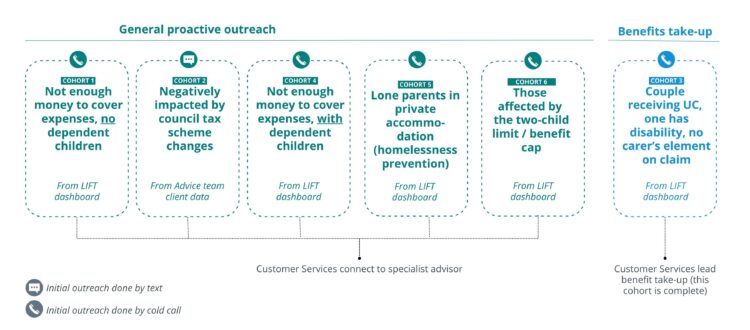
Greenwich proactive outreach

 Source: Royal Borough of Greenwich

The Greenwich Supports team led their proactive outreach using LIFT data dashboards to target specific vulnerable cohorts. This included residents struggling to cover expenses, lone parents in private accommodation, and those negatively impacted by council tax scheme changes or benefit limits. As a result, 55% of the residents the team worked with came from proactive outreach rather than standard referrals.

Over 20% of the individuals engaged required support from more than one advisor, most commonly needing a combination of employment and debt or benefits advice.

By leveraging data-driven insights, the LIFT platform identified households most in need, allowing the council to target support effectively. This ensured that limited resources were directed where they could have the greatest impact. Once the data were secured and the team reached out proactively, advisors were able to collaborate to provide coordinated and wraparound support. This combination of tech, data and multi-disciplinary teams cooperation resulted in significant outcomes for the community.

Impact: The pilot improved residents’ financial resilience and delivered significant savings for both residents and the council

After over a year with 525 residents, Royal Borough of Greenwich demonstrated that holistic, person-centred support yields significant returns. The pilot generated tangible success:

  • Financial gains for residents: Royal Borough of Greenwich secured £893,000 in financial gains for residents, averaging £5,300 per household through benefits maximisation and discretionary payments.
  • Council cost savings: 14 instances of homelessness were prevented. This early intervention saved the council approximately £30,000 this year and an estimated £355,000 over five years.
  • Payments and repayment to the council: over £70,000 in projected repayments were made through more suitable payment arrangements for council tax and rent as well as housing benefit overpayments and council tax and rent arrears.
  • Employment support: the Council successfully supported 21 residents into secure jobs, upskilled 32 individuals, and provided job-hunting support to 54 residents.
  • Debt management: the team advised on £1.3 million in total priority and non-priority debts.

Through integrated case management, Royal Borough of Greenwich efficiently stabilised complex cases and maximised residents’ income.

For example, when a resident was relocated due to domestic violence, the Council identified unresolved financial concerns. The team successfully corrected the resident’s Universal Credit claim, unlocking a monthly payment of £750 as well as an additional £1,400 lump sum in backdated funds.

Key takeaways

Through this pilot, Royal Borough of Greenwich identified a clear framework for preventative, holistic support that other local authorities can replicate to improve efficiency and community impact:

  • Access to multi-specialist teams support: Providing access to varied specialisms enables councils to address multiple resident needs immediately and catch underlying issues early.
  • Advisor autonomy: Trading constraints for operational flexibility allows advisors to support residents in the most effective way possible, leading to better outcomes.
  • Triaging beyond ‘presenting need’: Treating the ‘presenting need’ is often insufficient. Councils must view and understand residents holistically to achieve sustainable financial resilience.
  • Proactive outreach and good data: Leveraging accurate, real-time data is critical to reaching vulnerable individuals before they fall into crisis and require more resource-intensive interventions.
  • Income maximisation at the core: Combining financial assistance with employment support is highly effective in preventing further hardship.

Greenwich Supports demonstrates how local authorities can use data to deliver targeted support and build long-term financial resilience.
By combining proactive outreach, data-driven decisions, and income maximisation strategies, the programme prevents immediate crises. It builds sustainable recovery through integrated financial and employment support, reflecting the CRF’s core pillars of Crisis Support, Financial Resilience, and Local Support Networks.

Download printable PDF of case study

Royal Borough of Greenwich

Want to know more about what Greenwich Borough Council did?

By submitting this form I confirm that I have read the privacy policy and agree to the processing of my personal data by Policy in Practice for the stated purposes. I can revoke my consent to this processing at any time

Request a Demo

Name(Required)
Organisation name

Book a Call

Book a Call

Health Foundation report
scroll to top