More children will be eligible for Free School Meals from September, the next challenge is take-up

Miles Hession Published on 07th August 2026

While Keir Starmer’s premiership has officially come to an end, one of his most significant policies is about to come into force: the expansion of Free School Meals in England to more than 500,000 children from September.
Announced in June 2025 as a precursor to the 2025 Child Poverty Strategy, the government has estimated that these additional meals will lift over 100,000 children out of poverty.
More recently, following their victory in the 2026 Senedd election, Plaid Cymru have announced a similar expansion in Wales. From September, eligibility will be extended to students in Years 7 and 8, with plans to roll it out to all secondary school students in households receiving Universal Credit over the coming years.
But how will it all work? And how will it affect school funding?
All children in households receiving Universal Credit, in England, will become eligible for Free School Meals from September
In England, the 500,000 newly eligible students will join the 3.6 million already receiving a free meal. There will be a smaller expansion for those in Years 7 and 8 in Wales.
There will be three cohorts that will receive a free meal: the Universal, Expanded, and Targeted cohorts. The three groups can overlap, so the fact a child is receiving a meal at school does not mean they are necessarily registered. The diagram below shows how the groups overlap with an explainer of who is in each group below.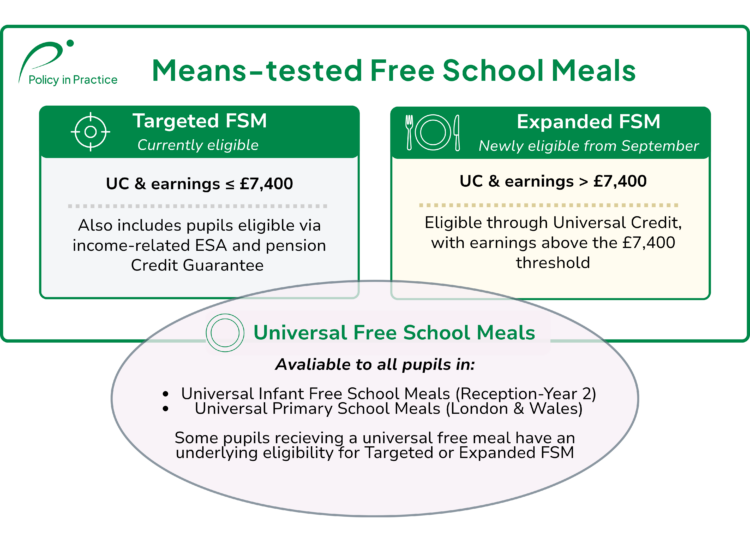
A key consideration for local authorities is that decisions related to school funding and the allocation of Pupil Premium in England, Pupil Development Grant in Wales, and Pupil Equity Funding in Scotland, take into account the number of children in the Targeted cohort. Therefore, local authorities must encourage and support families who meet the eligibility criteria to apply for free school meals in order to unlock additional support for schools.
Cohort 1: Universal FSM
While the Expanded and Targeted cohorts are subject to means-testing, the Universal group is not means-tested and does not require any application to get Free School Meals.
In England the Universal cohort includes all Reception to Year 2 students and in London and Wales all Primary school students receive a free school meal, with the additional support funded by the Mayor of London and Welsh Senedd respectively.
Cohort 2: Expanded FSM
In the Expanded cohort, a child in a household that receives Universal Credit will now be eligible for free school meals from September.
This will cover all children on Universal Credit from Reception to Year 11 in England. In Wales, this will include children in Year 7 and 8, with a planned rollout for all secondary school students in a household in receipt of Universal Credit in the coming years.
Cohort 3: Targeted FSM
The Targeted cohort includes students from nursery through to sixth form who meet the existing eligibility criteria. Children are eligible for free school meals if their household meet any of the following conditions:
- Receives Universal Credit and has an annual net income equal to, or less than, £7,400
- Receives income-related Employment and Support Allowance
- Receives support under Part VI of the Immigration and Asylum Act 1999
- Receives the guaranteed element of Pension Credit
Students in Targeted FSM can unlock over £2,400 per year in additional funding for schools and families
Families who claim free school meals receive support equivalent to around £500 per year in school meals. This support can go beyond school meals by making families eligible for holiday free meals outside term time.
Making a claim is particularly relevant for the Targeted FSM cohort, as it also unlocks funding for schools and families.
In England, a student in the Targeted cohort attracts additional funding to their school through the Pupil Premium, which ranges between £1,100 and £1,550 depending on whether they are enrolled in primary or secondary school, and the National Funding Formula, delivering £1,167 in additional funding per year for up to six years from each application.
Similarly, in Wales, each student in the Targeted cohort attracts £1,150 in Pupil Development Grant funding, as well as additional funding for their school through the National Funding Formula. Their family also receive support through the School Essentials Grant, worth £125 per year, with a higher payment for children entering Year 7.
The majority of funding is unlocked by the targeted cohort
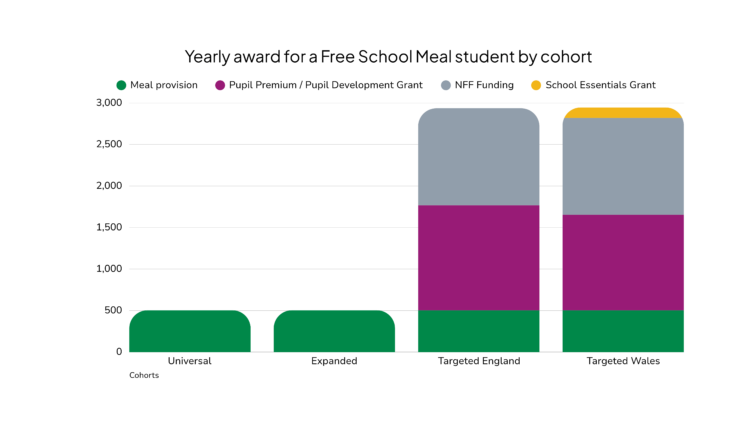
Students receiving free school meals through the Universal or Expanded cohorts will not attract this additional funding. Increasing Universal Credit take-up will help more children access free school meals, but eligible students must still be explicitly registered as Targeted to unlock the associated funding for their school and families.
Councils can identify children eligible for Targeted FSM and run take-up campaigns to ensure schools and families do not miss out on critical additional funding.
Free School Meals has a higher take-up rate than many other means-tested benefits. According to our analysis of administrative data, take-up is as high as 95%, largely due to proactive approaches adopted by local authorities. However, the overall eligible population is about to increase by 10%, so it is crucial that local authorities continue identifying and registering students.
Families that are eligible for free school meals may need a nudge in order to apply. If a student is receiving a meal through a universal programme, even if they are eligible under the targeted criteria, an application must be made to place them in the targeted cohort to attract additional funding.
Data-driven targeted take-up campaigns are one of the best tools at a school and local authority’s disposal in order to increase take-up and prepare for the newly eligible cohort.
Through the Low Income Family Tracker (LIFT) platform, eligible students can be identified and enrolled through targeted take-up campaigns.
Our work with Lambeth, Lewisham, and Wandsworth highlights the high ROI and impact that these take-up campaigns can have, with every £1 invested leading to an average savings of £800 per family and £2,200 in additional school funding.
Recent work with Pembrokeshire and Wrexham underscore the importance of these campaigns, attracting more than £1.2 million in savings for families through free meals and the School Essentials Grant, and £355 thousand in additional funding for schools.
"Income maximisation is one of the most effective, evidence-based and achievable tools for reducing poverty. The significant positive outcomes and financial gains shared in this report demonstrate that, through the use of LIFT, we are unlocking the powerful potential of a more data driven and targeted approach here in Pembrokeshire.”
Gemma Baker Policy and Performance Manager, Pembrokeshire County Council

Additionally, the LIFT platform and our analysts can support cross-authority campaigns. By working with neighboring local authorities, we can identify students who live in one area but attend school in another, helping ensure that no eligible child slips through the cracks.
The expansion of free school meals is a significant step in reducing child poverty and improving educational outcomes. Through data tracking and sophisticated targeted take-up campaigns, we can ensure that the full impact of each Free School Meals award is received by both the family and the school.
We are also piloting efforts to increase the take-up of Universal Credit, with the support of the Trust for London. This will help to ensure more children can benefit from free school meals by being on Universal Credit, as well as boosting the overall income of the household. If you want to learn about these efforts please contact us.