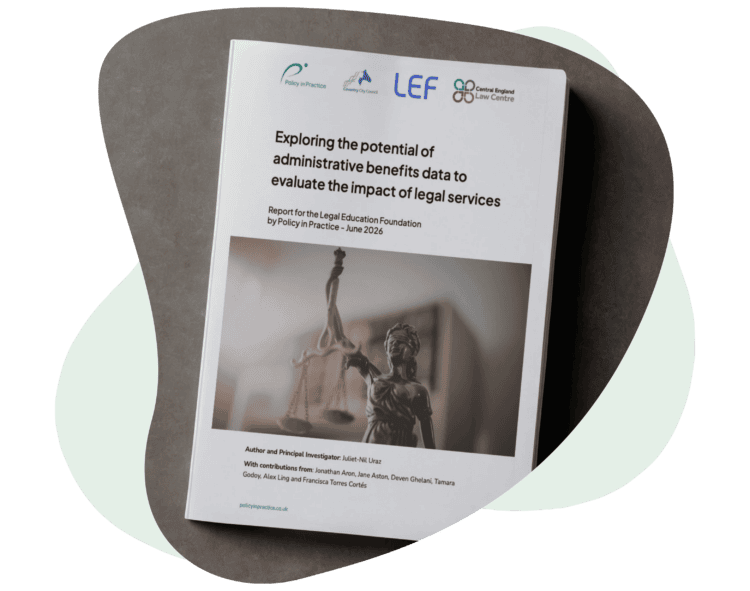
The transformative impact of legal assistance: evidence for local authorities

Juliet-Nil Uraz Published on 18th June 2026

For local authorities, funding free legal and welfare assistance is a constant balancing act against severe budgetary pressures. Delivery models vary across councils, ranging from dedicated in-house teams to a complex patchwork of grant-funded law centres and third-sector agencies.
Regardless of how these services are delivered, they always seem vulnerable to funding pressures. Even when it feels like the right thing to do, protecting them is made much more difficult by the lack of hard, data-driven evidence proving their long-term value.
Groundbreaking new research from Policy in Practice provides concrete evidence to bridge this evidence gap. The research objective was to explore the use of local authority administrative data in the evaluation of legal services receiving local support. In doing so, the report proves that funding holistic legal assistance is a highly effective intervention that directly reduces poverty, prevents homelessness, and fundamentally transforms residents’ well-being.
Shedding light on a successful 50-year collaboration between the Central England Law Centre and Coventry City Council, the research shows how active communication between the two partners, combined with the council’s continued commitment to core funding, has enabled legal assistance to reach its full potential. This partnership has allowed the law centre to support households across the full range of their legal problems, helping them find pathways out of poverty.
Local authorities can leverage these findings as a powerful strategic tool, whether to justify protecting existing funding or to build a robust business case for investment into local advice services.
The research: an unprecedented approach
While it is widely accepted that legal assistance helps people, proving it with hard data has historically been difficult. This study is the first of its kind in the UK to securely link a law centre’s casework data directly to a local authority’s administrative benefits data (covering Housing Benefit, Council Tax Reduction, and Universal Credit) thanks to the collaboration of the Central England Law Centre and Coventry City Council
By comparing those who received help against a matched control group of benefit claimants who did not, the research provides robust evidence of the value of people-centred legal services: meaning legal assistance that is proportionate to the needs of the individual, rather than restricted by the funding stream that pays for it. The methodology included:
- Extensive tracking of 110 matched households from 12 months before to 24 months after receiving legal advice
- A survey of 187 former clients alongside in-depth qualitative interviews, to capture outcomes beyond the administrative data and understand what makes the law centre’s work effective
The typical client profile
The importance of this research is underlined by the severe, overlapping crises faced by those seeking legal assistance. These struggles are deeply intertwined with high rates of disability and acute psychological distress. The study shows that the law centre’s client base differs significantly from the broader low-income population receiving benefits.
- Deep Poverty: The vast majority rely almost entirely on welfare benefits (only 19% are in paid employment). Over half live below the poverty line, with many having less than £100 a month after basic expenses, making them very unlikely to be able to pay for a private lawyer.
- Housing Precarity: Clients experience high rates of eviction and live in temporary accommodation at levels vastly exceeding the national average.
- Demographics: Disproportionately single adults or lone parents managing larger families
- Additional Barriers: Nearly a third face language barriers, and a significant portion are dealing with complex immigration issues.
The key findings
- Measurable financial gains and poverty reduction
Legal assistance directly improves the financial resilience of vulnerable households. Advisers provide specialist legal representation while also acting as critical navigators of the welfare state: identifying unclaimed entitlements, challenging wrongful benefits decisions, and using information gathered during legal cases to connect people proactively with healthcare, social and housing services. This holistic approach helps stabilise individuals facing acute crises.
- Increased Income: Households receiving legal assistance saw a £153 per month increase in their equivalised household income compared to the control group. Crucially, these gains did not appear all at once. They built up gradually and were sustained 18 to 24 months after intervention, reflecting the cumulative impact of Discretionary Housing Payment applications, Universal Credit reassessments, appeals and delayed administrative adjustments.
- Closing the Poverty Gap: The intervention led to a £50 per month reduction in the poverty gap, actively pulling families closer to the poverty line.
- Targeted Maximisation: For 20% to 25% of clients, the advice received was the decisive factor in securing benefits they would not have otherwise claimed.
- Preventing eviction and homelessness
Local authorities bear the heavy statutory and financial costs of homelessness, spending an estimated £3.8 billion on the crisis in 2024/25. This responsibility has been compounded since May 2026 by the Renters Rights Act, which mandates councils to actively investigate and enforce private housing laws. Consequently, the demand for housing legal advice is expected to increase substantially.
Legal services act as a vital stabilisation tool, helping prevent some households from becoming homeless while improving outcomes for those already in crisis.
- Tenancy Preservation: Among social housing tenants facing active eviction proceedings, 83% successfully retained their tenancy following intervention, keeping them out of expensive emergency council housing.
- Managing Crises: For those who had to enter Temporary Accommodation, legal assistance ensured their benefit packages were comprehensive, improving their real purchasing power by £54 per month after housing costs.
- Supporting monitoring and earlier intervention: As local authorities take on new enforcement responsibilities under the Renters’ Rights Act, collaboration with specialist legal services can help councils make better use of intelligence from housing disputes. This can support earlier intervention, more targeted enforcement, and better coordination between legal advice, housing and welfare support.
- Transforming mental health and wellbeing
People arrive at the law centre in acute distress, often facing housing issues, rent arrears, financial pressures, and health-related challenges. interacting clusters of housing, debt, and health crises. Clients overwhelmingly highlighted the profound psychological relief of having an expert take their side.
- High Initial Distress: Over half (56.6%) reported feeling anxious before contacting the service, and nearly two-thirds attributed their mental distress directly to their legal problems.
- Immediate Relief: Among those receiving intensive assistance, 72.5% reported feeling better after their contact with the advice service, often starting from the very first meeting.
- Building Capability: Following the intervention, 57% understood what to do next, and 53% had a better grasp of their legal rights.
“I ended up on antidepressants… I was literally suicidal, on the edge. I just remember them phoning me, saying, got some good news for you… It was the biggest weight on my shoulders. It was amazing. And we’ve managed to keep out of arrears since.”
(Client, possession case)
- The limits of signposting and the value of specialist triage
The research highlights a stark reality regarding capacity constraints. When underfunded, services are forced to turn people away and external referrals often fail because other providers are facing similar pressures. However, the findings also show that even limited specialist assistance can make a measurable difference, particularly where it is tailored to the person’s circumstances rather than reduced to generic signposting.
- Referrals rarely work: Of the clients referred elsewhere due to capacity limits, only 23% actually successfully received help at their destination, reflecting pressure across the wider advice sector.
- Light-touch specialist advice still delivers value, even when it cannot resolve every legal problem: Four in ten clients who only received light-touch specialist assistance, rather than intensive casework, reported their problem was still entirely unresolved months later. However, this group still saw positive impacts on income and poverty alleviation, pointing to the wide-reaching value of specialist advice even when full representation is not possible.
- Specialist triage protects quality under pressure: Flexible core funding allowed the law centre to offer personalised one-off advice to residents whose housing problems fell within the scope of the service. Unlike legal aid or short-term project funding, core funding gave the team the flexibility to draw on specialist expertise, consult colleagues where needed, and tailor advice to the person’s situation. This provided a more effective alternative to basic signposting, helping manage demand without reducing support to generic advice or referral.
- The value of local authorities and advice services working together
The report focused on services provided by the Central England Law Centre, and Coventry City Council. A key learning from the project was in the power of collaboration.
- Strong trust and a partnership approach was needed to link law centre data to administrative data held by the local authority, through the LIFT analytics platform.
- These strong relationships also led to some emerging legal issues to be resolved faster. However, limited capacity often forces the law centre to provide support only once the client’s situation has reached crisis point, rather than when problems first begin to emerge.
- The core funding provided to the law centre allows support to go beyond a narrow case-by-case response. By avoiding a short-term, project-based model, this funding enables the law centre to invest in specialist staff, data infrastructure and wraparound support that help address the underlying causes of residents’ legal problems and prevent repeat crises.
Policy recommendations for local authorities
Based on the research, local authorities are encouraged to adopt the following strategies:
- Protect and increase core funding for advice services to enable a people-centred approach: Legal assistance clearly works and saves the government money in the long run by directly preventing the need for expensive temporary council housing and crisis interventions. But it only works if support does not have to stop halfway because of silos and uncoordinated funding streams. Supporting core running costs gives legal services the time horizon they need to hire, train and retain specialist staff, maintain outcome-oriented data infrastructure, and build the long-term capacity to deliver holistic assistance.
- Fund responsive, cross-domain support: Sustain funding for early intervention rather than waiting until residents are at the point of crisis (e.g., the day of an eviction hearing), or qualify for a specific grant-funded project. Funding should empower advice centres to tackle overlapping problems, including housing issues, benefit challenges, and the financial pressures that often accompany them, at any point of the legal journey. A narrow, case-by-case approach risks missing opportunities for income maximisation, leaving unclaimed entitlements and incorrect benefit decisions unaddressed, even where these are central to stabilising their financial and housing circumstances.
- Collaborate and use existing data to prevent crises: Local councils and legal services should establish secure pathways to share administrative data. Residents facing legal problems often show markers of specific vulnerability in the council’s data. This allows authorities to proactively identify people at risk of legal crises such as homelessness before it escalates further, and ensure they receive their full legal entitlements. The Renters’ Rights Act will for example mean that local authorities need to support residents to take on a stronger role in identifying and enforcing lawful landlord behaviour.
Conclusion: the value of holistic advice
This research conclusively demonstrates that specialist, cross-domain legal assistance works . When a service can address the “whole person” and accompany them through the full legal journey, the outcomes are transformative. This means combining legal support, housing advice and representation, benefits checks, and referrals to mental health and social services, without having to stop support where legal aid or short-term project funding end. For a local authority, funding a specialist legal advice facility is an investment in homelessness prevention, poverty alleviation, and community health. The data shows that without these services, vulnerable residents face circular referral journeys, deteriorating mental health, and escalating crises that ultimately cost the public purse far more to resolve.