
Empowering local authorities to solve the NEET crisis with better data

Jennifer Downie Published on 29th May 2026

New statistics confirm that more than a million young people are not in education, employment or training (NEETs) in the UK. This group of NEETs has been growing since the pandemic and 1 in 8 people aged 18 to 24 are now in this position.
But why is this? What has been causing the recent increase in NEETs?
That’s the question the Milburn Review’s interim report, published yesterday, has sought to answer. Policy in Practice submitted evidence to inform the publication, and we look forward to publication of the full and final report including recommendations in September 2026.
No single factor is driving this rise in NEETs - instead the report identifies a combination of changes in work, education and health
In particular, Milburn highlights three factors holding young people back:
- Changes to the labour market over recent years have impacted young people’s employment, in particular a sharp decline of entry-level jobs. Milburn refers to figures from the Office for National Statistics stating that the number of mid- and lower-skilled jobs over the past 20 years has fallen by around 1.6 million, while higher-skilled jobs have grown by around 6.3 million.
- Drops in spending on, and capacity in further education have limited the sector’s ability to counter this weaker labour market by providing education to those struggling to find work.
- The report acknowledges that job-seeking young people with a disability often struggle to access support due to high caseloads and a lack of understanding of which barriers need removing to enable them to enter work. Ill health is also resulting in young people becoming NEET, with 1 in 5 children and young people in England citing a mental health condition.
The welfare system is failing in its role to support young people’s participation in education and work
The report also focuses on the role of the welfare system in preventing and supporting NEETs. It is critical of interactions between young people and welfare, citing these as ‘administrative’ rather than used as an opportunity to support them into work. It also highlights how nearly half (44%) of NEETs are ‘hidden’: they are not claiming out-of-work benefits and so miss out on support the system has to offer.
In our response to the consultation, we highlighted how the current design and level of benefits can discourage independent living for young people. This means that first steps into work are financially risky, and the need to rely on parental support reduces the feasibility of moving to areas with better job opportunities. In particular, younger claimants receive a lower standard allowance, less council tax support, and no work allowance. Minor fluctuations in working hours can cause high taper rates to be applied to all earnings, leaving young people to navigate income cliff edges and often driving them into financial precarity.
Debate about yesterday’s report has contrasted the benefit income received by young people with the provision of employment support, implying an overly generous system is holding NEETs back. But due to lower benefit rates, income support for young people is not particularly generous, nor is it the reason why we are failing to deliver effective employment support. Rather than viewing them as competing, both must be prioritised to give young people the financial stability they need to participate in work or education.
Local authorities are well-placed to support NEETs through data-led, place-based interventions
The Milburn Review will be providing their recommendations and solutions later this year. But we don’t need to wait until September to know that local policy interventions will be key.
Local authorities are uniquely placed to understand their local labour markets, demographic trends, and landscape of support services. By combining this knowledge with granular administrative data, they can:
- Act early, providing targeted and personalised interventions informed by local data
- Improve their engagement with young people at risk of becoming long-term NEET
- Ensure resources are directed where they can have the greatest impact.
We know local authorities want to play this role, and many are already making innovative use of data.
But they are being held back by data-sharing restrictions. For example, access to Universal Credit data is largely limited to households with a Council Tax liability and excludes extensive data on dependants and non-dependants living in the household. This limits visibility of many young people at risk of long-term inactivity.
Local authorities require better and broader data to identify less visible young people. We recommend that the UK Government expands data sharing between the Department for Work and Pensions and local authorities. Specifically, it should provide local authorities with Universal Credit data for households that do not have a Council Tax liability.
When local authorities have access to timely, linked administrative data, evidence shows that outcomes improve.
Impact story of a council using data to support young people into employment
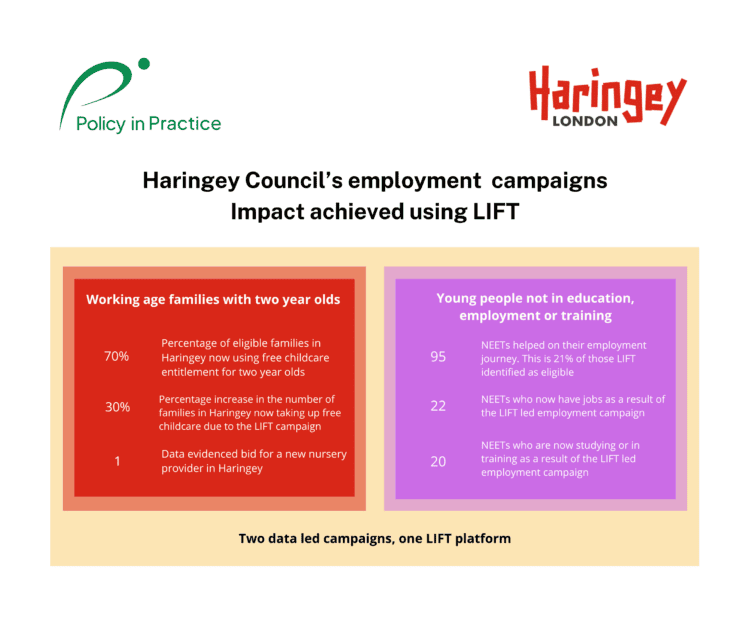
Haringey Council used the Low Income Family Tracker (LIFT) to identify over 460 households containing a young person classified as NEET. These households were sent targeted leaflets outlining employment, skills and financial support they were missing out on. Follow-up phone calls and emails encouraged eligible young people to register for support. Awareness was also raised through posters in local youth centres and DWP offices.
LIFT insights identified wards with particularly high numbers of NEETs, enabling targeted social media campaigns via Instagram and Snapchat. Social media outreach proved especially effective in reaching young people not in receipt of benefits and therefore not visible through traditional data sources.
Since the campaign launched in February 2023 over 95 young people registered for employment and upskilling support. By July 2023, 22 had started work, 16 entered education, three began traineeships and one started a basic skills programme.
With reform, the benefits system and mental health services can better support the transition to adulthood
A vast disconnect exists between young people’s mental health needs and available support. A postcode lottery in Child and Adolescent Mental Health Services (CAMHS) means waiting times can range from six to over 100 days. The transition between CAMHS and Adult Mental Health Services (AMHS) is a troubling ‘cliff edge’, where long waiting lists worsen symptoms and break trust. We recommend implementing a 0 to 25 young adult mental health pathway.
The benefits system can better support independent living and transitions into work. We recommend:
- Aligning benefits for young people living independently with the support available to those aged 25 or over
- The introduction of a Work Allowance for single people without children
- Removal of the Local Housing Allowance Shared Accommodation rate for young people
Join our webinar
To hear more about the work local authorities are doing to support young people into work, join our upcoming webinar on 23 June: “Efficient and sustainable employment support: Blueprints for a data-led, holistic strategy”
We will explore how local authorities and sector partners can build sustainable, long-term financial resilience for residents.
This session will look at how proactive outreach, income maximisation and multi-disciplinary teams can prevent immediate crises and keep people engaged in support programmes, in line with the recent CRF guidance.