The essential role online calculators play in closing the £24 billion unclaimed support gap

Deven Ghelani Published on 29th January 2026

This week, the Money and Mental Health Policy Institute (MMHPI) published its new report, In Touching Distance, examining why people with financial and mental health challenges continue to miss out on support they are entitled to.
We were pleased to contribute to the report and to take part in MMPHI’s parliamentary roundtable yesterday, bringing together charities, policymakers, utilities, financial services providers and advice organisations to discuss how access to support can be improved.
The report’s publication comes at a moment of increased public attention on unclaimed support, including recent BBC coverage about online calculators that highlights how vulnerable people can struggle to navigate complex systems. Together, these conversations point to a shared challenge of how support is delivered, how people discover that support exists in the first place, and what happens next.
“Benefit calculators play an important role in helping people understand what financial support they may be eligible for, and in supporting advisers to give the most comprehensive advice they can. They work best as part of a wider suite of support, alongside personalised, human advice by phone or face to face, so people can access help in the way that works for them. That’s why we support a blended approach, where digital tools like LIFT help advisers identify potential eligibility, and Apply Once connects people to one to one support when it’s needed. Proactive, data led approaches and simpler application journeys reduce the risk of people missing out altogether.”
Deven Ghelani, Director and Founder Policy in Practice


Deven Ghelani and Rob Johnson, Policy in Practice, attended the Money and Mental Health Policy Institute’s parliamentary roundtable to discuss the importance of improving access to income maximisation support
The £24 billion question: why support goes unclaimed
An estimated £24 billion of financial support goes unclaimed every year. That figure, now widely referenced across the sector, comes from our annual Missing Out analysis.
One of the main reasons for this gap is that many people do not know what benefits or other financial support they are entitled to, leading to at least 8 million households missing out on vital support. Other factors such as system complexity and stigma make the problem worse but lack of awareness is the starting point. You cannot claim support you don’t know exists.
Any serious attempt to close the £24 billion gap has to begin with surfacing entitlement in ways that are timely, intelligible and trusted.
Discovery first: the role of calculators, used properly
Benefit calculators play a critical role at this discovery stage and are an essential tool for advisers. They enable the delivery of consistent and comprehensive support and are an enhancement, not replacement for one to one advice.
Used well, reputable online calculators:
- Help advisers give more comprehensive and consistent advice
- Allow advice services to reach more people than would otherwise be possible
- Surface potential entitlement that may never emerge through conversation alone
- For many people, this is the first time they see their potential entitlement set out clearly
Our Better Off Calculator, which is listed on GOV.UK and recommended by government, is used by frontline organisations across the country in precisely this way. help advisers give more comprehensive advice and can act as a gateway to one to one support by phone or face to face where it’s needed. Calculators are a connecting route into triaged support.
The limits of discovery alone
Discovery, however, is not enough on its own. Even when people become aware of their entitlement, many still struggle to complete applications, provide evidence, or navigate multiple disconnected processes, especially when they are dealing with illness, caring responsibilities or acute financial stress.
There is also a further group who never reach discovery at all: people who do not complete a calculator, or never start one. If systems rely solely on individuals coming forward and self-identifying, many of the people most in need will continue to miss out.
This is where system design becomes decisive.
From reactive to proactive: removing the burden altogether
Reducing unclaimed support at scale requires moving beyond reactive models and investing in proactive approaches that remove friction altogether.
In practice, this means:
- Using data responsibly to identify people who may be eligible for support
- Minimising the number of times people have to explain their circumstances
- Designing joined up “Apply Once” journeys rather than multiple applications
- Enabling auto-enrolment by connecting data silos
Through services like Apply Once, and partnerships with organisations such as the Greater London Authority and Thames Water, we’ve helped put over £50 million into people’s pockets. Much of this support has been delivered automatically, without people needing to navigate complex application processes at all.
Our work with Nationwide Building Society identified £14 million of unclaimed support in the first four weeks of launch through a fully inclusive benefits checking service that offers both a self-serve online and app calculator, and a free expert telephone helpline. This dual approach ensures that people who can’t or prefer not to use digital services still receive exactly the same level of support. The key to the solution was creating a seamless user experience.
For people least able to advocate for themselves, this kind of design is not a nice to have. It is the difference between receiving support and missing out entirely.
What we heard at the Money and Mental Health Institute’s parliamentary roundtable
At the parliamentary roundtable discussion following the report’s publication, there was broad agreement on one point: no single mechanism solves the problem on its own.
Effective support systems combine:
- Discovery tools that identify entitlement to income support
- Adviser support that interprets and contextualises it
- Proactive identification of people who may never come forward
- Automatic pathways, where possible
A critical point that we felt was missed in the report is that benefit calculators and application forms are complex because the system itself is complex. Online tools play an essential role in connecting advice and systems together and, when properly sequenced and integrated into a customer journey, will reduce drop off at every stage. However, the burden to apply for support is determined by policymakers, and we have seen with one hand Universal Credit bringing application processes together, while on the other, a growing fragmentation of local support in response to the cost of living crisis.
What needs to change
If we are serious about closing the £24 billion gap, the focus needs to shift away from the role of individual tools and towards end to end journeys.
That means:
- Treating income entitlement discovery as essential
- Supporting advisers with the tools they need to reach more people
- Designing systems that do not rely on persistence, confidence or spare capacity
- Using data to reduce, not redistribute, administrative burden
The goal is not to digitise existing complexity. It is to remove complexity altogether, wherever possible.
Moving forward
The publication of In Touching Distance and the conversations it has sparked are welcome.
If we want the unclaimed £24 billion to reach the people it was intended for, we must design inclusive systems that respect people’s circumstances and capabilities, especially when they are under financial or mental strain, instead of placing the burden on individuals to navigate complexity on their own.
That is how unclaimed support stops being a statistic and starts making a real difference in people’s lives.
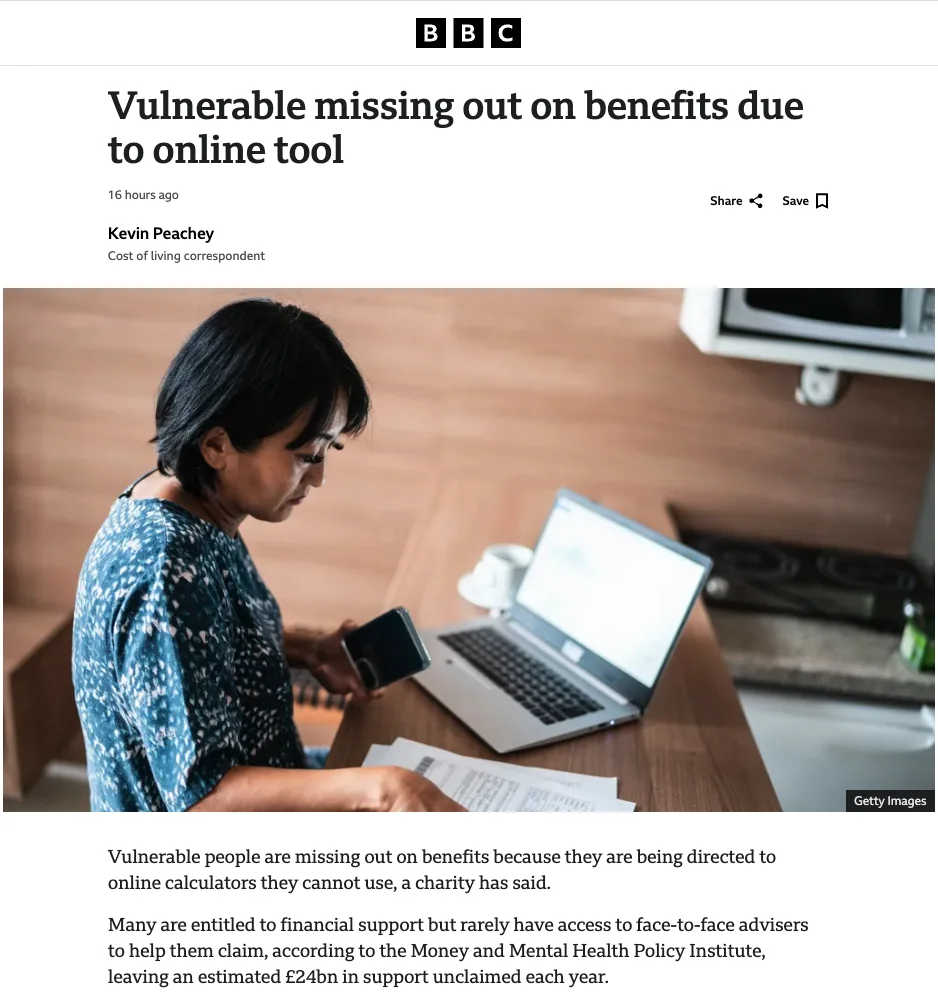
BBC article highlights why making support accessible matters just as much as making it available